How to Optimise Your Store for Google AI Overviews and Chatgpt Search
Google and ChatGPT are changing how customers research products. Unlike before, when users would be shown ten results for a short-term question, users can now ask more detailed questions, compare options, and get recommendations directly from the AI-powered search.
The scale is already alarming. According to Google, AI Overviews now serve over 2.5 billion monthly active users, and AI Mode has already crossed the 1 billion users per month mark. Google also states that AI Overviews are offered in over 200 countries and regions.
The question that ecommerce businesses need to ask themselves is instead “How do we rank in AI?”
It is: When a customer asks a relevant buying question about our products, can an AI system clearly understand, trust, and refer to our products?
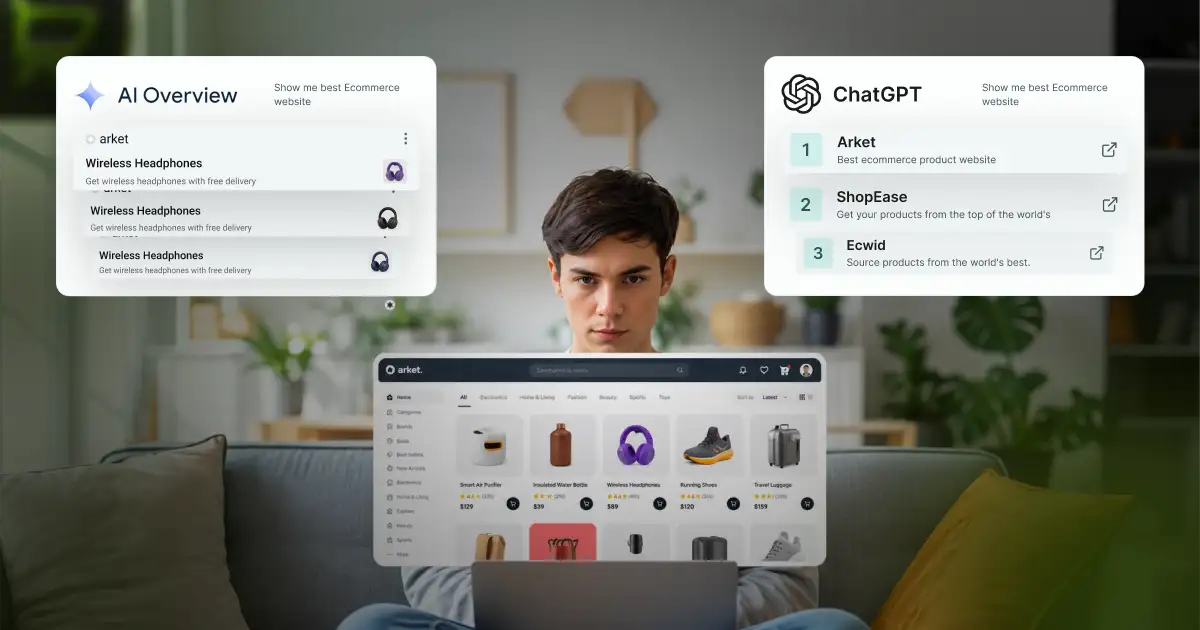
AI Search Is Changing the Type of Query
A common starting point for traditional SEO is keywords like “office chairs” or “running shoes.”
AI search spurs much more targeted questions:
- Which office chair will be best for 8 hours of work a day?
- What are the differences between these two running shoes?
- What laptop would be the ideal choice for a small business?
- Does this skin care product work for sensitive skin?
According to Google, AI Mode queries are twice as long, on average, as traditional Search queries, and its earlier testing revealed queries to be two to three times as long, on average.
These are significant questions, and your store should give enough context for them.
Optimise Product Pages for Decisions
A product page should help customers decide whether to buy a product or not, which is the core of conversion rate optimisation.
Begin with information that a customer might need before spending money:
Provide Clear Product Evidence
Include specifications, dimensions, materials, ingredients, compatibility, pricing, availability, delivery, returns and warranties as readily available information.
Don't use only images for key product details. Google advises to provide crucial content in text with the same technical SEO underpinnings used for traditional Search.
Answer Pre-Purchase Questions
Include succinct responses to questions that customers ask.
For instance, a laptop page might cover:
- Is this laptop appropriate for work/business needs?
- What is the capacity for storage?
- Is it capable of running heavy applications?
- Which ports does it contain?
- Which model should be looked at if it is not that one?
This provides AI systems with valuable and explicit details, instead of having to 'work out' the information from the promotional text.
Convert Category Pages to Purchasing Guides.
A category page should make customers' options more manageable.
Rather than a section of the website dedicated to 40 products called “Running Shoes”, include helpful buying paths:
- Shop By Use
- Road running
- Trail running
- Long-distance running
- Beginner running
- Shop By Requirement
- Maximum cushioning
- Lightweight
- Stability
- Wide fit
This structure gives rise to more defined product relationships with categories and customer needs.
Google suggests a logical website structure and internal links for ecommerce sites to help it understand the relationship between category page, subcategory pages and product page.
The same architecture also provides AI systems with more context when deciding what product to suggest when a specific question is posed.
Create Content with Buying Issues
Remember to not produce content just because a keyword has a search volume.
Write pages to answer customer decision problems.
Useful formats include:
- Product comparisons
- “Best for” guides
- Alternatives
- Buying guides
- Compatibility guides
- Troubleshooting pages
- Cost comparisons
- Product selection checklists
For instance, rather than writing a generic piece on the office chair, a furniture company could write a piece about “Best Office Chairs for Long Working Hours”.
Google's AI search advice right now particularly highlights content that is helpful, original, and focused on users or people over content of low value that's merely created for search engines.
The competitive advantage wouldn't be "more content. It's better information, not bad information, that assists someone to make a decision.
Keep Product Data Consistent
AI visibility can reveal vulnerabilities in your product information.
Ensure that your website, Merchant Center feed, and other sources of products are consistent on:
- Product names
- Prices
- Availability
- Specifications
- Images
- Variants
- Delivery information
- Brand details
For online retailers, Google suggests having accurate and up-to-date Merchant Center details.
This can be an operational or SEO issue. When product information is stored separately in an ecommerce platform, inventory system and marketing spreadsheet, discrepancies can start to show up easily.
This one reliable product-data-source can then benefit search accuracy and daily business operations.
Fix Technical SEO Before Chasing AI Tricks
Google doesn't have a specific “AI SEO” feature to ensure a page can be included in their AI Overviews.
Google states that pages must be crawlable and indexed in accordance with the normal standards for Search. It also states that there are no special schema or AI-specific machine-readable file requirements for AI features.
Prioritise:
- Crawlability
- Indexation
- Internal linking
- Canonical URLs
- Clear headings
- Useful page titles
- Mobile usability
- Structured data matching visible data
- High-quality product images
- Accurate product feeds
Avoid wasting time creating content around AI topics when critical product pages aren't available, don't link, or get the wrong page ranking.
CTA: Need a store built for AI search? Ecommerce Excellence offers ecommerce website development with technical SEO built in.
Check Your OpenAI Search Visibility
Google and OpenAI are two things that should be considered as two discovery systems.
OAI-SearchBot is OpenAI's search service for crawling websites to provide search for ChatGPT. OpenAI says that sites that opt out of the OAI-SearchBot won't be displayed in ChatGPT search answers, but they might still be there as navigational links.
Verify that important commercial pages are not inadvertently disallowed by the robots.txt file.
Please keep in mind that OpenAI differentiates OAI-SearchBot from GPTBot, which is used for crawling during training. Separate controls are used.
It's one of the fastest technical tests that an ecommerce team can carry out.
Measure AI Search Performance
AI visibility isn't just about manual searches every now and then.
Google has added new Search Console reporting for generative AI capabilities, like AI Overviews and AI Mode. Google states that these insights are available to websites all around the world as of 31 August 2026.
Track:
- AI-related impressions
- Organic clicks
- Product-page visibility
- Category-page performance
- Search queries
- Conversion rate
- Revenue from organic traffic
- Visibility for priority buying questions
The aim of the commercial activity is not just to be displayed in an AI answer. The objective is to be a valuable asset along the customer's buying journey.
Conclusion
Optimizing Google AI Overviews and OpenAI Search is NOT a replacement for SEO.
The better route to take is to create an ecommerce website that has informative product pages, helpful information that helps customers make purchasing decisions, a solid internal structure, trustworthy data, and technically sound infrastructure.
Needs like that are more critical in the context of AI search, as the AI systems that respond to customers' queries must have accurate information to operate.
When you can really answer the questions of what the product is, who it's for, why somebody should buy it, and what they need to know about it, you are solving a problem for the customer and for the search system.
Frequently Asked Questions
No, Google states that the basics of SEO are still applicable to AI Overviews and AI Mode. There are no additional technical requirements specifically for these features, so businesses should prioritise crawlability, indexation, useful content, internal linking, page experience, and accurate structured data.
Yes, To ensure your website appears in the search answers provided by ChatGPT, OAI-SearchBot should have access to the content. This crawler is used by OpenAI exclusively for search and is separate from GPTBot's operations.
No, structured data does not guarantee visibility in AI search. It helps Google better understand your products.