AI Chatbot for Ecommerce: What £199/Month Actually Buys You
For a long time, ecommerce was a game of keywords and filters. Visitors entered specific phrases into search boxes and moved through page after page of categories and abandoned their shopping journey as soon as they couldn’t find what they wanted. In the present day, an AI shopping assistant also known as an AI chatbot for ecommerce, has changed the eCommerce shopping journey. Instead of set search, a shopping assistant at £199 a month, integrates with your catalogue, checkout and inventory.
When looking into the best shopping assistant for your brand, you will quickly realise that the £199/month can give an ecommerce store a useful conversational shopping tool, but it will not buy an unlimited sales assistant.
Consumers can write their needs in a natural language instead of specifying product names. But not all will offer live stock, checkout actions and advanced personalisation at this price. Check the plan’s limits before you buy.
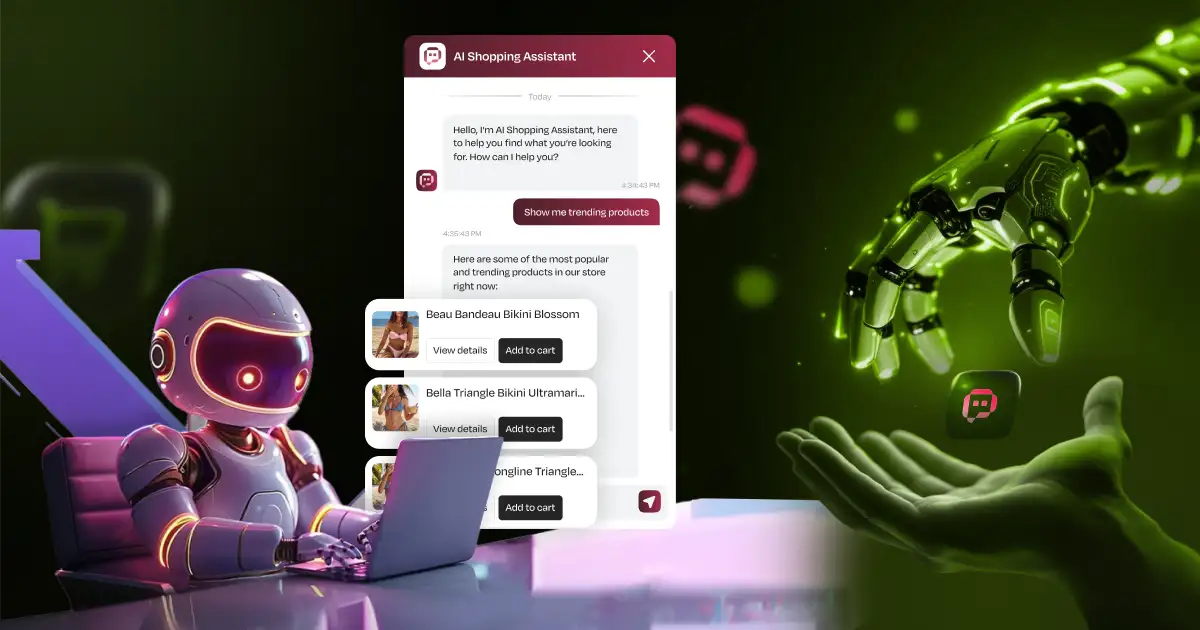
The Reality of a £199/Month AI Shopping Assistant
The shift toward AI-powered shopping assistance is gaining momentum, with the AI shopping assistant market projected to reach $84.60 billion by 2034. The right assistant depends on what you need it for. The retailer that’s looking for product discovery cannot have the same setup as the company that’s using it primarily for customer support.
How Many Conversations Does a £199 Plan Cover?
Most £199 plans include 200–500 conversations a month. A “conversation” usually counts the entire interaction, including the original question, through to a successful “intent” and does not count each individual prompt. The platform will charge an overage fee (usually £0.80 to £1.00 per extra resolution) if your traffic load increases and you exceed this limit.
How Many Products Can a £199 AI Shopping Assistant Handle?
A £199 tier usually restricts the active AI inventory to a range between 1,000 and 10,000 SKUs. For brands with high levels of product customisation or thousands of different pieces, an AI shopping assistant free tier or mid-level plan might not be sufficient to accurately process the entire database. An enterprise upgrade may be necessary when dealing with large catalogs.
How Often Does a £199 Plan Sync Your Catalogue?
A £199 plan typically syncs your catalogue daily or every 30 minutes, not in real time. When in a business with lots of flash sales or inventory that goes in and out regularly, a delayed sync might result in the assistant recommending a product which is no longer in stock.
What Does a £199/Month AI Assistant Actually Do For Ecommerce?
A £199/month AI shopping assistant helps ecommerce businesses automate customer support, recommend products, answer shoppers’ questions, and guide them toward purchases.
How Does an AI Shopping Assistant Understand Customer Intent?
Traditional site search needs exact keywords. A modern shopping assistant AI is good at interpreting a wide range of questioning, open-ended questions, and conversational language. A customer might write, for instance, “I want a sturdy winter coat for a hiking trip that is under £150," and the assistant will immediately display the exact matches and why they meet the criteria.
Can a Shopping Assistant Compare Products?
An AI virtual shopping assistant can compare products directly in the chat window, reducing the need for multiple tab openings for customers. A customer might ask, “What’s the difference between product X and product Y?” The assistant will evaluate attributes, customer reviews, and dimensions and provide a break-down that can easily be scanned.
Help Recover Abandoned Carts
Specialised Shopify AI integrations can track on-site behaviour or specialised Shopify AI integrations, track user behaviour throughout e-commerce sessions. When a customer is unsure on the checkout page or is sitting on a product without putting it in the cart, the assistant will start a context alert asking for guidance or a relevant discount to prevent cart abandonment, a core part of any conversion rate optimisation plan.
Add Products to the Basket
The most effective assistants don’t just send you back to the product pages, they also help sell them. They are able to add discount codes, change quantities, and add items straight from within the conversation, thus creating a seamless way to buy.
What AI Shopping Assistant Capabilities Should You Look For?
As per the latest AI shopping assistant news, several retail giants and tech firms are experimenting with conversational shopping in various forms. Ask the provider seven questions prior to registration:
- For £199, how many conversations or visitors can you get?
- Which products and variants does it have access to?
- How often does it update catalogue and stock information?
- Does it correctly put the right product variant in the cart?
- What eCommerce platforms does it support?
- If customers go over the monthly allowance, what happens?
- Are there opportunities for staff to monitor conversations and to intervene if necessary?
How Do AI Shopping Assistants Compare Across Ecommerce Platforms?
The right tool depends on where your customers shop. The Amazon Rufus AI shopping assistant is an artificial intelligence tool designed to assist shoppers in researching and comparing products on Amazon. Rufus cannot be installed on the retailer’s website.
In the same way, the Google AI shopping assistant can help users find products throughout Google’s ecosystem.
Depending on the product, a Shopify AI shopping assistant can help customers discover products in the Shopify ecosystem or the merchant’s own shop. Shopify also provides discovery tools to consumers via Shop, and retailers can have their own tools installed on their respective stores.
An AI that focuses on customer support may be the better option if you simply want to automate basic product questions.
If you’re looking for consumer-facing discovery tools, think of the Tesco AI shopping assistant or one of the AI shopping assistant apps, which help users identify products in a variety of stores.
How Do You Calculate the ROI of a £199 AI Shopping Assistant?
When picking an AI assistant for ecommerce websites, the only way to determine whether it’s a worthwhile purchase is to estimate the return on investment (ROI). Data suggests that AI-powered sessions have a much higher conversion rate than regular traffic on websites.
To calculate your exact break-even point on a £199 budget:
- Break-even formula: £199 ÷ average contribution margin per order = extra orders needed each month.
- For instance, if your average contribution margin per order is £50, then the assistant has to generate or save around 4 more monthly orders to support £199.
- Your break even will be different based on margins, previous conversion rates and the influence of the assistant.
Conclusion: Is a £199/Month AI Shopping Assistant Worth It?
For most small and mid-sized stores, £199/month buys a capable assistant covering product discovery, recommendations, comparisons and basic customer guidance.
Prior to purchasing, look out for usage limits, catalogue size, data-sync frequency, platform integrations, cart actions, reporting and human handoff. Then try it with actual customers’ questions. In addition look at how the provider deals with incorrect answers, unavailable products, price variations and integration failures.
Book a free AI readiness check with Ecommerce Excellence to see whether an assistant fits your catalogue, platform and goals.
Frequently Asked Questions
Businesses that are already on Shopify should usually opt for a Shopify shopping assistant as it integrates effortlessly with your current catalog and checkout system. If you’re looking for a simple option, you may use a shopping assistant free plan to experience conversational attributes without a subscription.
A typical chatbot is programmed with answers to common questions, like shipping or return periods. By contrast, a shopping assistant for ecommerce reads your live catalog data, understands intricate customer requests, proposes products with the help of product parameters, pushes products to the shopper’s cart, and so on.
Usually, no. It can answer repetitive questions prior to purchase, however, when it comes to complaints, unusual requests, or sensitive cases and conversations, that should be handled by human staff.
Yes, for many small and medium-sized stores. However, there may be restrictions on conversations, visitors, catalogue size, integrations or data updates; make sure to review the provider’s terms prior to purchase.