Does an AI Shopping Assistant Actually Increase Conversions?
Yes, an AI shopping assistant can boost conversions, but only when it fixes a real buying problem.
Well, a customer visits your website, figures out 2-3 products, then takes time to compare new features, and sadly leaves the website. You've checked your website. Everything seems ok. Maybe the customer didn't make up their minds.
This is one of the most underrated problems in ecommerce. Companies invest a lot in driving traffic to their product pages, but it's possible that the last thing they need is someone to answer the question in the customer's mind. In a store, that person is a "Sales Assistant". This can be done with an AI shopping assistant, too. However, does it actually boost conversions, or is it just a feature that looks good in a demo? Yes, it can help drive conversions, but only if it solves a real purchasing problem. It’s one of the most underrated problems in ecommerce.
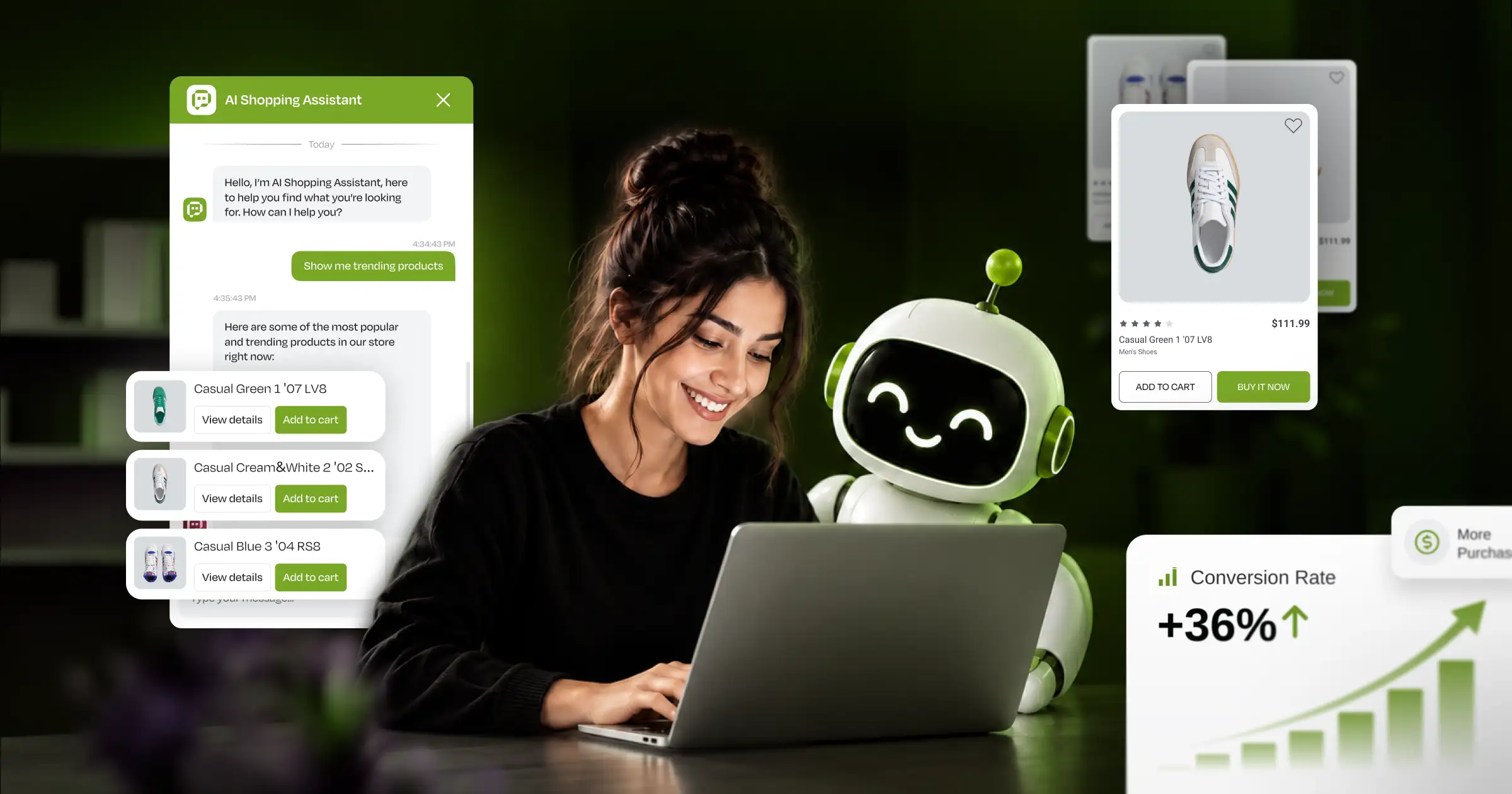
Why Do Customers Leave Without Buying?
Traffic does not necessarily result in sales.
A customer can turn away because they don't know which of two products to choose. They might not know the size, be unsure about compatibility, not know how it will be delivered, or not know whether a product is suitable.
This is increasingly significant as the number of products in catalogues increases.
Search for “laptop” and a customer may face hundreds of choices. They don't need more products. They need help choosing.
An AI shopping assistant can close that gap.
It lets your customers describe what they're looking for instead of having to go through filters, menus, and product descriptions.
Customers Are Using AI to Discover Products
Over one third of consumers and around 55% of Gen Z are seeking AI help for product research.
Product discovery is shifting from the search box to conversation. Customers now expect to ask questions and get specific answers.
An assistant lets your site answer those questions directly, so customers don’t leave to search elsewhere.
What Does an AI Shopping Assistant Do?
An AI shopping assistant should be more like a good salesman and less like a chatbot.
The assistant should not answer with a general response to the question, “Which one should I buy?” It should ask about the customer’s needs first.
How Does an AI Shopping Assistant Reduce Choice Paralysis?
Excessive options can be a conversion challenge.
Suppose you have a customer who is searching for a sofa. They have hundreds of options and just know that they need something for a small living room that is easy to clean and not more than £1,500.
A classic ecommerce journey could involve going through several filters.
An AI assistant can pose some helpful questions and whittle down the list of possibilities.
For example:
Customer: “I need a sofa for a small flat.”
The assistant asks whether they want a two- or three-seater and whether easy-clean fabric matters.
The discussion brings the customer closer to the sale.
So, the true intent behind conversational commerce is to make the choice easier.
Turning Pre-Purchase Questions into Sales
Purchasing customers frequently have questions just prior to the purchase.
- “Will this fit?”
- “Is this appropriate for students at the beginning of their studies?”
- ” What’s the difference between these two models?”
- “Can I return it if it’s the wrong size”
- “Will this work with my existing equipment?”
Can an AI Shopping Assistant Increase Average Order Value?
Conversion is not the only thing that counts.
A good assistant can also suggest products that genuinely go together.
The difference between helpful suggestions and upselling.
The “Customers who buy this also buy…” is well known. Compare that with: “These two lenses fit this camera, and this one is lighter, so it’s better for travelling”.
That distinction matters.
Why AI Shopping Assistants Need Good Product Data
This is where a lot of AI shopping projects crash and burn.
The Assistant can only be as useful as the “information behind it.”
If these same issues occur in your product catalogue, such as out-of-date prices, missing product specifications, or inconsistent descriptions or stock information, the AI can provide similarly inaccurate responses.
This makes the assistant more than just a text-generating machine - it can actually aid with eCommerce decisions.
Where Does Human Support Fit In?
Well, the use of AI Tools should not be a barrier to connect with human needs. Your business can automate a few very simple questions to connect with your customer conveniently.
The use of AI tools should not be a barrier to access to a human.
There are questions which are so simple that they can be automated.
If there is a broken delivery, a technical issue or an unusual refund situation, it could be scored by a customer.
AI is used for routine and repetitive decisions, and humans for decisions that require judgment.
This also can help to save support staff time in having to answer the same basic questions over and over.
What are the best use cases for AI Shopping Assistants?
If you are making a decision on what product to use, AI may be of more assistance.
Ready to Turn More Browsers into Buyers?
Book a free consultation and we’ll show you where shoppers are dropping off and how an AI assistant built on your product data could close that gap.
Final Thoughts
An AI shopping assistant is valuable not because of how it uses AI but because it provides better value to the customers.
It's great when it takes away something that prevents a customer from purchasing.
That can sometimes be a confusing product catalogue. It may be a size problem. There are times when it's due to lack of compatibility or the options just aren't enough.
The potential of AI-powered shopping assistants is most likely to be advantageous to companies that know how to make the most of them. This is the one, that starts with a clear customer problem, and then goes to the AI.
Find out what are common inquiries from customers prior to buying. You should be able to answer these questions quicker and have a better understanding if more people are completing the process.
Your AI shopping assistant will help customers navigate through your store, improve product discovery, and support conversion rate optimisation by providing personalised recommendations, answering queries, and guiding shoppers towards purchase decisions. Track its impact on sales and measure how it influences your overall conversion rate.
Frequently Asked Questions
There is no consistent uplift in conversion. It is influenced by products, customer journey, product data quality, and the ability of the assistant to tackle buying objections. Improvements have been documented in published company case studies, but need to be confirmed with in-house testing.
Not necessarily. There is a basic chatbot that can answer certain questions you program it to and there is an ai shopping assistant that will figure out what your customer wants and search through your products and compare and recommend.
Depending on how many products you have, what you want it integrated with. What ai you use and if you want customer data used. Automation etc. Your shopping assistant will need to be able to do things such as look up orders. So a shopping assistant that only does product recommendations will be much cheaper then having it do everything for you.
An AI shopping assistant is valuable not because of how it uses AI but because it provides better value to the customers.