What Founders Running Shopify and Magento Tell Us on the First Call
For UK businesses generating between £5 million and £50 million in annual revenue, choosing an ecommerce platform is about more than comparing features. It is about supporting growth without adding unnecessary complexity, cost or operational risk.
Ecommerce founders often face five key challenges: over-reliance on developers, rising app and maintenance costs, undocumented business processes, complex B2B pricing requirements, and the risk of losing organic search traffic during migration.
Shopify powers over 4.8 million live websites worldwide (BuiltWith, 2026), but popularity does not guarantee suitability. Magento and Shopify Plus offer different advantages, and the right choice depends on your business model, operational needs and growth plans.
Below are the five concerns we hear most often on first calls, and how each one plays out on Magento and Shopify.
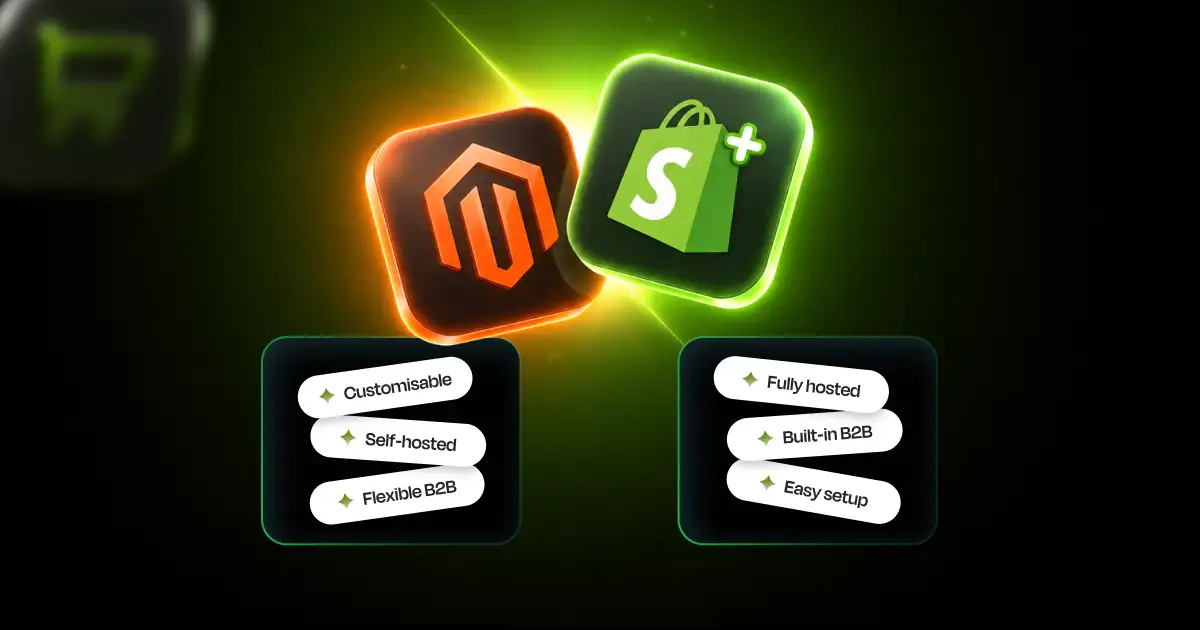
Magento Needs Developers for Small Changes, Shopify Needs More Apps
Both Magento and Shopify Plus can create unexpected costs, but the challenges differ.
- Magento relies heavily on developers: Updating a navigation menu, editing a product page or launching a seasonal campaign can require development tickets, testing and deployment, turning simple changes into lengthy tasks.
- Delays can cost sales: When teams cannot implement changes quickly, campaigns may miss their deadlines. Meanwhile, hosting, maintenance, security updates and compatibility testing continue to consume budget.
- Shopify apps can create conflicts: Adding a product bundle app to increase average order value might seem straightforward, until it clashes with a subscription tool and disrupts the checkout experience.
- Costs build up differently: Magento expenses often centre on specialist development and infrastructure maintenance. Shopify costs can rise through app subscriptions, integrations and customisations.
Neither platform is automatically cheaper. The key is understanding which option delivers the functionality your business needs with less unnecessary complexity and more predictable ongoing costs.
The Hidden Migration Risk: Processes Only the Founder Knows
A founder may be aware of specific price breaks for a certain distributor, or that some customers are eligible to buy in bulk at a reduced rate, or that wholesale orders require approvals of certain functions.
However, to make this specific structure work, most decisions still sit with the founder. As the company adds sales staff, distributors and overseas markets, this becomes harder to control.
That is why a good ecommerce partner maps your business processes before recommending a new platform. This means capturing customer groups, price levels, approvals and integrations and not merely copying the existing shopfront.
Complex B2B Pricing and Multiple Stores on Shopify and Magento
Platform decisions get harder when a business sells to both consumers and trade customers.
Magento supports multiple storefronts and customer groups with flexibility in architecture, catalogue structures, and customer-pricing. Such functions may suit distributors and manufacturers to different regions, brands, or wholesale accounts. But complex customisations need specialist ecommerce website development and continuous testing.
Shopify Plus has some native B2B features, such as company accounts, catalogues, and price lists. These tools cover most typical wholesale requirements without custom code.
Rankings and Order Processing Are Affected in a Migration
During a migration discussion, the founders are more concerned about keeping the orders moving and protecting income, than about a clean or new site.
1. How to Protect SEO Rankings During a Platform Migration
You might have a good established store on Magento with thousands of product pages, category URLs and even indexed filters and backlinks that are a collective work of several years of development. When platforms change, it can result in different URL constructions, page format templates, internal links, and metadata.
Without proper planning of migration, the search engines may detect missing pages or that or find pages redirected to irrelevant ones.
Migration plan:
- Plans should include crawling the existing site, recording useful URLs, building a cogent 301 redirect map, and auditing metadata and canonical tags, structured data, and internal links.
- A team is supposed to test the new site prior to launching, and monitor for indexing as well as traffic and errors after.
2. Will Your ERP and Warehouse Systems Still Work After Migration?
The second is how data moves from the storefront to back-end systems like NetSuite, the warehouse or a management system such as SAP (WMS).
They can control inventory, order status, and customer records, as well as trade rates and order fulfilment. However, if there are disruptions in the migration, the business may present incorrect availability, or slow orders.
- Before development, identify every API and system integration and check how often data needs to sync.
- It should also apply error handling, duplication of orders and recovery procedures and failed synchronisation.
- A UK ecommerce agency can coordinate development, SEO, data and operations during a migration.
Founders Want Less Maintenance and Faster Store Updates
Magento suits companies that need deep customisation in their code and structure. This versatility may be beneficial if the business has really unique needs. However, all of these custom details introduce complexity that developers need to comprehend, test, and support.
Shopify handles hosting and infrastructure, but businesses still need ongoing maintenance and support for apps, integrations, custom code, security and performance.
Magento and Shopify Plus: Cost, Control and B2B Features at a Glance
Founders need to understand the features that provide real commercial value before swapping out the platforms.
| Business requirement | Magento | Shopify Plus |
| Development control | Wide customisation and source-code control | Customisation within Shopify’s apps and extensions |
| Infrastructure | Needs separate hosting and maintenance | Fully hosted by Shopify |
| Ongoing costs | Hosting, development, maintenance and upgrades may become expenses too | Subscription, apps, integrations and custom development may all be expenses. |
| Best fit | Companies that have specific workflow demands | Businesses that require process optimisation and managed infrastructure. |
This will depend on which architecture is in use, the skills of the team, the kind of integration required and the cost of maintaining the required functionality.
8 Things to Check Before Moving from Magento to Shopify
The migration process becomes easier when the business has been able to answer all the questions before the development process.
- Auditing custom modules: Figure out the features that are essential to the main business processes and features that are unnecessary and outdated.
- Map catalogue and pricing policies: Map customer segments, product differentiations, bargain and regional differences.
- Document ERP, and WMS integration: Document data flows, data update times, ownership and failover requirements etc.
- Check all the apps and extensions: Uninstall all unnecessary applications as much as possible but retain all the active ones.
- SEO migration planning: Map old URLs to target URLs that are relevant, develop redirects and record the current organic performance.
- Plan customer and order data: Find customer and order records that need to be migrated, and the data will be mapped and how the staff will confirm it.
- Multi-store strategy: Discuss with regions, brands, currencies, languages and wholesale accounts, how they should act on the new platform.
- Plan for launch and rollback: Test integrations, checkout, inventory, redirects, analytics & fulfilment prior to switching the live site.
Any agency should review these points before quoting a timeline or budget.
Should You Stay on Magento or Move to Shopify Plus?
Choosing the wrong platform is one of the costliest mistakes in ecommerce.
So, do you consider moving an online store on Magento to Shopify, or are you just planning to assess your current ecommerce platform? Book a technical architecture audit with Ecommerce Excellence to understand your platform limits, integration risks and SEO exposure before you migrate. Learn your technical limits on the platform, risk integration, or SEO, and develop a migration plan to meet your business requirements.
Frequently Asked Questions
Larger businesses can use Shopify Plus since it offers internal teams control over the changes in a storefront. However, this is subject to the custom functionality, B2B requirements, integration as well as the total cost of ownership.
The time frame will be based on the catalogue size, custom modules, data quality, multi-store demands, and ERP integrations.
Yes. When URLs are modified, redirects are lost, metadata is changed, and internal links are broken; this may adversely affect organic visibility. A documented redirect map, pre-launch testing and post-launch monitoring reduce the risk.