Can AI Development Improve my Post-Purchase Experience?
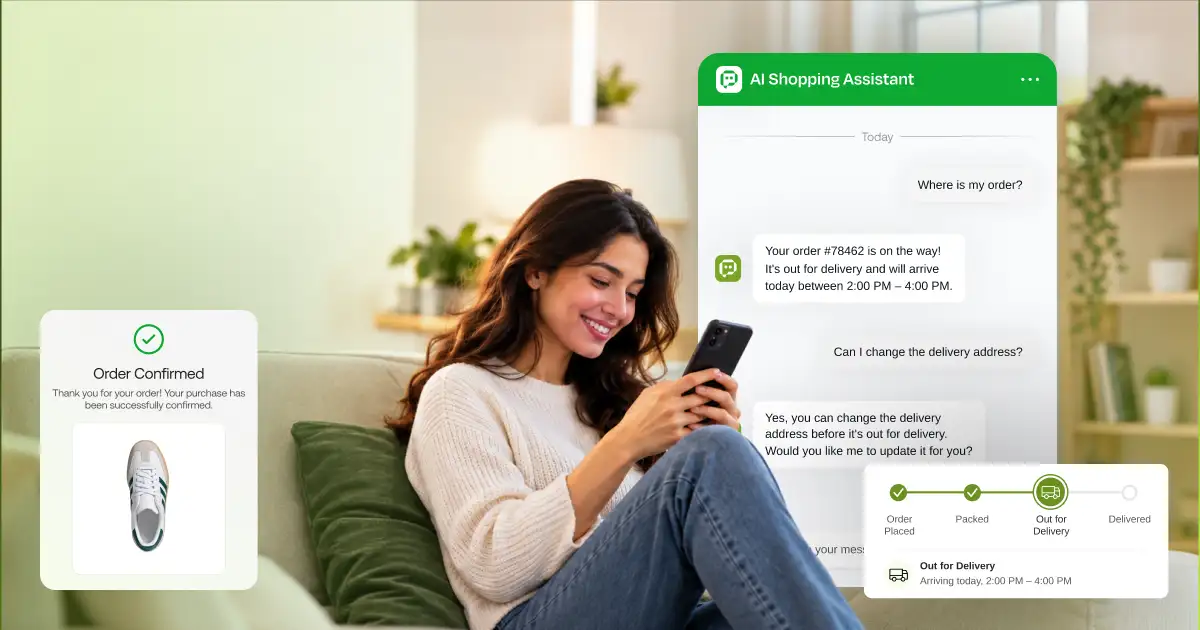
The customer makes a transaction. The money passes through, the order is placed, and sales move on to the next lead. However, the customer experience doesn't end there. Customers often have several questions and concerns until they receive the products they ordered:
- Where is my order?
- At what time will it arrive?
- Is it possible to change the delivery address?
- What do you do in case of an error?
- What is the reason for not yet having an answer?
These questions create a lot of work after the sale. Customers now expect instant answers, and support staff are being forced to trawl through data across multiple CRM and order systems, emails and knowledge bases for what they want. AI for eCommerce development will be one of the key drivers to remove this disconnect and transform customer support from reactive to proactive and more personalized.
Why Does Post-Purchase Experience Get Overlooked?
The problem is not always because of a lack of data. In many businesses, information to help the customer is already in place, but it is spread across multiple systems and tools that are not connected.
According to a study of post-sales customer experience by Deloitte, the percentage of customers who were not very satisfied with the post sales customer experience was about 60% of the customers surveyed. It also discovered that 35% of Customer Success Managers' time was devoted to gathering account updates and customer data from a variety of tools.
That poses two issues.
Customers have to wait longer to get responses and employees waste precious time searching for information that's out there somewhere within the company.
AI can link these two issues together.
How AI Can Improve the Post-Purchase Journey
Don’t rely on an AI chatbot on your support page alone. The greater potential lies in integrating AI with existing systems engaged in the customer journey.
That means integrating AI with your existing systems, such as your CRM, product database, ticketing tool, order management system and knowledge base.
1. Give Customers Instant Order Support
It should not be necessary for the customer to engage a member of staff for simple order details.
An AI assistant can interface with order-management data and answer such questions as:
- Where is my order?
- Has my order shipped?
- When will my order arrive?
- Can I change my delivery address?
- What’s the status of my return?
- When will I get my refund?
Instead of having to go through the cumbersome process of wading through emails and waiting for an agent to reply, the system can retrieve relevant information and reply to the customer.
This can be especially useful when there is a promotion, product launch or a seasonal time when support volumes rise.
2. Personalized Help
You may say “Please look at our return policy.” which may be true it will not help the customer with there question. What they want to know is if they can return their item and what they need to do.
When someone is calling about a item they wish to return a ai bot could be used to pull this information from the companies database. Allowing the support team to not have to double check the order and purchase date and return policy. Say a customer purchased a pair of shoes on the 5th of October and wants to return them on the 10th of October. The bot could look at the purchase date and see if they fall under the return policy. Then provide them with the next steps (ie. How to begin the return process, will they have to box up their item and wait for pickup etc.). This would allow the customer to receive a helpful answer quicker and the support team would have more time to focus on more difficult questions.
3. Move from Reactive to Proactive Support
One of the major applications of AI is predicting problems before they are reported by customers.
Suppose an ecommerce business notice there are hundreds of orders from one warehouse that have not moved in a couple of days.
The ai would be able to pick up on the abnormality and begin that work flow instead of having to wait on customers to report it.
Deliveries may be delayed, and a new delivery date may be provided to customers.
The same approach works for subscriptions and B2B orders.
Proactive and predictive support are two of the key tenets of AI-powered after-sales service that Deloitte highlights.
4. Convert Customer Conversations into Business Intelligence
Post-purchase conversations hold insights most businesses never use.
Customers regularly raise issues such as:
- Difficult installation
- Confusing product instructions
- Delivery delays
- Packaging problems
- Missing features
- Billing issues
- Difficult returns
5. Improve customer self-service
If the customer is not able to find the correct answer, then it is not self-service.
In fact, Deloitte found that 25% of all support tickets were generated for problems that were previously discussed in one of their knowledge bases.
This is where the AI knowledge assistant can come in handy. AI can read the question and retrieve the appropriate information and provide a concise response, instead of the customer having to visit dozens of help articles. It may also help the customer by guiding them to the appropriate guide, policy or troubleshooting if the customer requires human or detailed documentation. The objective is not for people to have AI to justify their support. It is meant for eliminating unneeded resistance.
6. Train Human Agents on resolving cases quickly
AI can be used as an assistant as well. AI can pick up on what customers have already told them in customer support calls and provide them with details about their orders and remind them of anything still to be done. The agent does not have to begin from scratch since he/she has the context. This will be helpful to use if a case is transferred to another department.
But Deloitte found that the organisations that were able to segment customer engagement saw a 1.7 chance of a response within four hours.
AI-driven routing can aid in routing cases based on urgency, complexity, customer profile and agent capability.
Final Thoughts
Post-purchase experience is the period after purchase, when a business can support and reassure its customers. AI development can help to enhance that experience by enabling faster, more contextual and more responsive support. However, it's not simply just having an AI chatbot on a website. It's the ability to store all the data and the working systems of customers, and intelligent workflows, so that the business could get the right answer to the right question at the right time, in the right context. One of the most frequent post-purchase problems is linking the data that is required to help solve the problem and measure the outcome. That’s a better starting point than adding a chatbot because everyone else has one.
Frequently Asked Questions
No, not all, but it can take care of most simple questions and help expedite the answer for many issues. You always want to allow room for humans to step in as well. Have the option to escalate or have a self-service route if you are unable to properly answer your customer’s question with your AI.
It will depend on what you are using it for. Order information, CRM, products, shipping, tickets, communication from customers or even information in your knowledge base. You just want to make sure your data is flowing where it needs to, not every piece of data that you have.
Measure business and customer metrics. Some may include: first-response time, time to resolution, number of tickets, number of repeat contacts, customer satisfaction, amount of escalations and cost per contact. If you have your AI being proactive, then measure how many potential issues you’re finding and fixing before the customer contacts your support team.